Welcome to Pacific Coast Salmon Coalition and the salmon habitat restoration!
Rivers and streams along the Olympic Coast of Washington are the last Salmon stronghold in the Pacific North West. Salmon fisheries are one of our richest natural resources and crucial for a healthy and balanced ecosystem. Salmon are intertwined with our community; the cornerstone of Native culture for the four Tribes that inhabit the four major watersheds of the Olympic Coast, and an important part of the local economy giving opportunity for recreation and provide a natural beauty for all to enjoy.
You will find everything you need regarding Salmon habitat restoration efforts on the rivers and streams of the Olympic Coast through this online portal.
The Pacific Coast Salmon Coalition is a regional fisheries enhancement group actively involved in local volunteer-based habitat restoration to achieve a healthy salmonid resource within our region. We are one of 14 Regional Fisheries Enhancement Groups in Washington State.
Restoring salmon populations in the rivers and streams of the West Olympic Peninsula has been a monumental undertaking. We are working towards a restored environment that maintains a healthy self-sustaining salmonid population, a salmonid resource we can utilize and enjoy far into the future, a local community that not only utilizes the resource but one that takes responsibility and is actively involved in the well being of that resource, and a strong working relationship with all relevant entities that have a vested interest in salmonid habitat restoration.
The coverage area for the Pacific Coast Salmon Coalition (PCSC) includes the western portion of the Olympic Peninsula north of the Chehalis River drainage and south of Cape Flattery. This region covers parts of three counties: Clallam, Jefferson, and Grays Harbor. There are several significant rivers in this region; the Quillayute River Complex, which includes the Sol Duc, Calawah, Dickey and Bogachiel Rivers; the Hoh River, the Queets River and the Quinault River. These rivers are glacially fed and have short, but steep drops to ocean. High levels of precipitation characterize the region and streams with cold water, high average flows, and relatively long duration peak flows during the raining seasons, including a second peak later in the year from snow melt.
Much of this area is within the Olympic National Park and Olympic National Forest, the Washington State Experimental Forest, or one of several Native American reservations. The majority of the land base in the river drainage is in timber production. The remaining land base is primarily a mixture of National Park and Native American Reservation.
One of the primary challenges for PCSC is obtaining volunteers in a very large area with a very low population density. The challenges for the volunteers are to blend the needs of salmon with the area’s economic dependence on logging and fishing and because so much of the region is in public lands their efforts must be coordinated with various state, federal, and tribal land managers.
However, because of this unique circumstance several beneficial partnerships have formed. To date, the Pacific Coast Salmon Coalition has formed partnerships with the Quillayute Tribe, the Hoh Tribe, the Makah Tribe, Quinault Tribe, USDA Forest Service, National Park Service, WDF&W, DNR, Forks School system, Rayonier, Green Crow, Blodell, the City of Forks and numerous small private landowners.
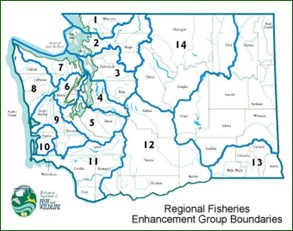
RFEG stands for Regional Fisheries Enhancement Group. There are 14, non-profit, RFEG regions in Washington State which are led by a parent group, the Regional Fisheries Coalition. To find out more visit the RFEG site, or click on any of the 14 groups to visit their site.
The RFEG program is a Washington State legislated program to further the efforts of restoring Washington’s Salmon stocks in all historical salmon bearing watersheds. They work in partnership with landowners, tribes, local businesses, government agencies and other NGO (non-government organization) non-profits to protect and restore wild salmon populations.
Salmonid Screening Habitat Enhancement and Restoration (SSHEAR)
In the late 1980s Washington Department of Fish and Wildlife was looking for a way to improve salmon returns in Washington’s rivers. The method they used was to improve juvenile salmonid rearing habitat; after doing a survey of the Quillayute, Hoh and Clearwater watersheds they found 800+ potential enhancement sites. These sites were high quality off channel rearing habitat that had the potential to be enhanced.
Approximately 60 of the potential sites were selected to be enhanced or ‘improved’ using a variety of techniques. The improvements at most of these sites were meant to increase the area and depth of already high quality off channel salmonid habitat. Lumber and log weir controls, excavation of ponds and installation of fishways were used to increase habitat capacity while maintaining fish passage through the structures.
For more than a decade WDFW maintained and monitored these enhanced sites. It wasn’t until 2004 that PCSC took over maintenance and has been doing it ever since. Scores of volunteers and thousands of hours of labor have gone into keeping this vital habitat open to access for the many species of fish that utilize them.
Hatchery Surplus Fish – Food Quality
Every year thousands of salmon and steelhead return from the ocean to the fish hatcheries where they were spawned, raised and released from. Once they return many are used for the next batch and are spawned. This leaves an enormous surplus of fish waiting to be utilized. Early on in their return, most of the fish are of food quality, this gives our community an invaluable resource, sustenance. Here we will talk about the food surplus returns, on our Nutrient Enhancement page you can learn about what happens to the fish that are not food quality.
PCSC has been partnering with the Sol Duc Salmon Hatchery and the Bogachiel Steelhead Hatchery for more than a decade to gather, process and deliver this rich natural resource to those who need it the most. Partners and beneficiaries in this program are the Quileute Tribe, the Hoh Tribe, Forks Food Bank, Feed the 5,000 in Forks, and the Forks Masons. The surplus salmon must go to a non-profit organization with a letter of recommendation approved and registered by WDFW.
Nutrient Enhancement
Every year thousands of salmon and steelhead return from the ocean to the fish hatcheries where they were spawned, raised and released from. Once they return many are used for the next batch and are spawned. This leaves an enormous surplus of fish waiting to be utilized. Late in their return, most of the fish are old and passed their food quality state. All food quality fish are donated to non-profit community organizations or are received by the local Tribes, but the non-food quality salmon are still highly utilized as nutrient enhancement in our watersheds.
The carcasses of returned salmon are very rich in macronutrients, in a natural system the salmon would return to their home stream, spawn and die, leaving their body to break down in the stream feeding the whole system. Hatchery fish have no stream to go home to, they return directly to the man-made pools they came from, and thus aren’t spread far and wide through the watershed to recycle their nutrients.
PCSC has 20+ years of nutrient enhancement experience. The program started with 200+ miles of Quillayute River Watershed enhanced directly with surplus carcasses. We have now integrated analog placement of nutrients in other watersheds throughout our region as well.